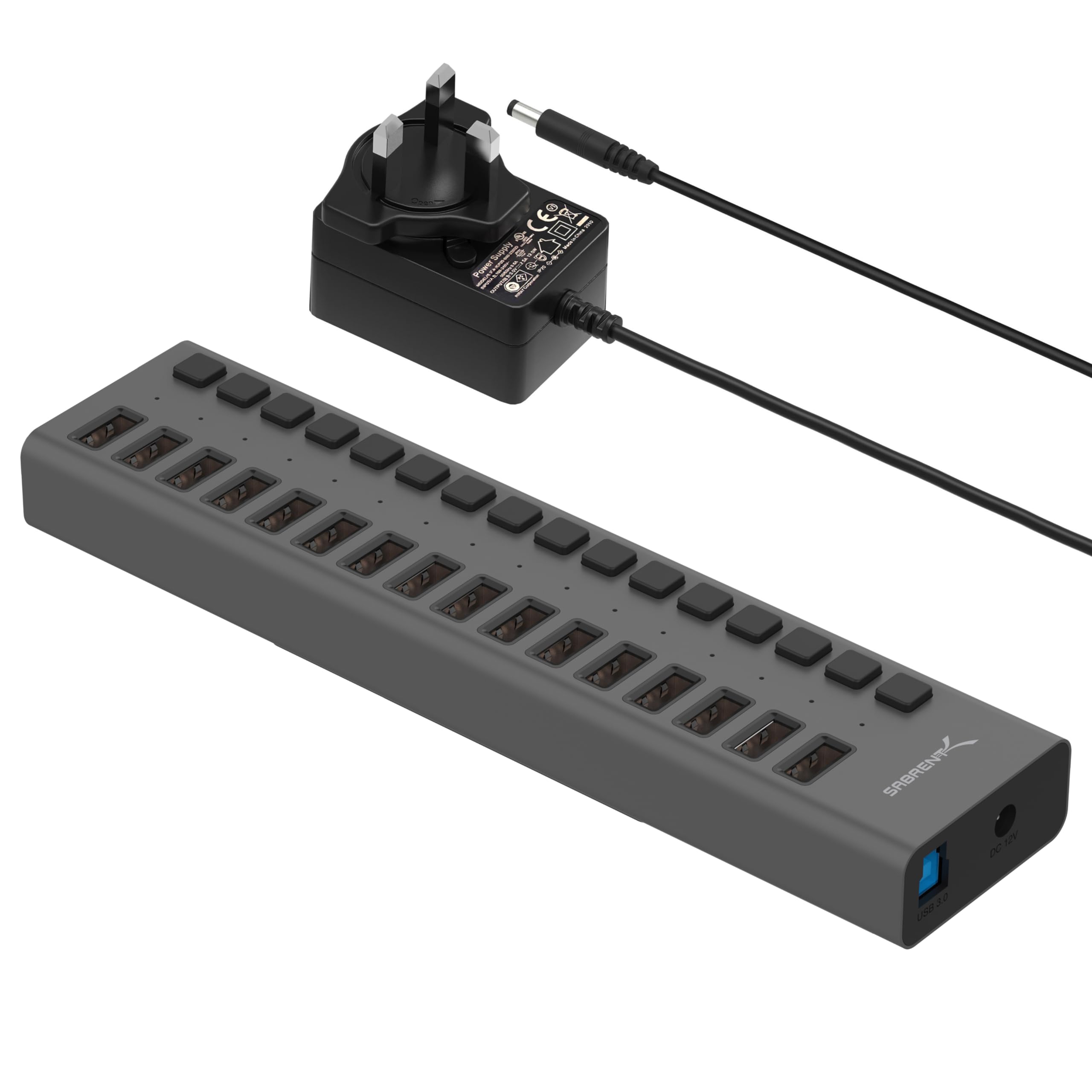
The SABRENT HB-PU16 is a powered USB-A hub designed for workstations that connect many peripherals at once.
This SABRENT HB-PU16 review looks at its 16-port layout, USB 3.0 support, individual switches, and the practical tradeoffs of choosing a large desktop hub.
SABRENT HB-PU16 Review Summary
The quick verdict
1,000+ ratings
Read Amazon ReviewsSABRENT HB-PU16
A fit for desktop users who need many USB-A connections, individual port switches, and support for older USB devices.
- Sixteen downstream USB Type-A ports for connecting multiple peripherals.
- USB 3.0 data transfer rates of up to 5Gbps.
- Compatibility with USB 2.0 and USB 1.1 devices and transfer modes.
- Individual power switches let you manage each port separately.

Pros
- High port count can reduce the need to rotate devices through a smaller hub.
- Individual switches offer convenient control over connected ports.
Consider before buying
- Sixteen ports may be more capacity than a typical laptop or lightly equipped desk needs.
- Its USB-A focus may not suit a setup that depends on USB-C connections; check the ports on the host and devices you plan to connect.
Read the full review summary
The HB-PU16’s defining benefit is capacity: 16 downstream USB-A ports let you keep a large group of peripherals connected through one hub.
USB 3.0 supports transfer rates up to 5Gbps, and compatibility with USB 2.0 and USB 1.1 gives it flexibility for a mix of newer and older devices.
Individual power switches and blue status LEDs add useful control at each port.
This design is most compelling for a fixed desk with external drives, flash storage, card readers, and other USB peripherals that would otherwise need repeated swapping.
Its port count can be excessive for a laptop user who only needs a couple of extra connections, so consider the actual number of devices you use together and whether the hub’s desktop-oriented layout suits your space.
The buying factors
SABRENT HB-PU16 Scorecard
Editorial scores reflect listed features and buyer fit; they are not laboratory measurements or customer ratings.
Port capacity
Sixteen downstream ports give a crowded workstation room to connect many USB devices at once.
Data speed support
USB 3.0 supports up to 5Gbps, with lower USB 2.0 and 1.1 modes supported for compatible devices.
Per-port control
Individual power switches make it possible to control connected ports separately.
Device compatibility
The hub supports USB 3.0, USB 2.0, and USB 1.1 peripherals, including storage and other USB accessories.
Status visibility
A blue LED for each port helps show power status at a glance.
Compactness
A 16-port hub prioritizes connection capacity, so it makes more sense at a desk than in a travel kit.
Key Features and Specifications of SABRENT HB-PU16
- Sixteen downstream USB Type-A ports for connecting multiple peripherals.
- USB 3.0 data transfer rates of up to 5Gbps.
- Compatibility with USB 2.0 and USB 1.1 devices and transfer modes.
- Individual power switches let you manage each port separately.
- Blue LEDs indicate power status for each port.
- Plug-and-play and hot-swappable operation.
- Supports USB flash drives, card readers, external hard drives, and other USB peripherals for access or charging.
Pros and Cons of SABRENT HB-PU16
Pros
- High port count can reduce the need to rotate devices through a smaller hub.
- Individual switches offer convenient control over connected ports.
- Per-port blue LEDs make powered connections easier to identify.
- USB 3.0 support combines with backward compatibility for older USB peripherals.
Consider before buying
- Sixteen ports may be more capacity than a typical laptop or lightly equipped desk needs.
- Its USB-A focus may not suit a setup that depends on USB-C connections; check the ports on the host and devices you plan to connect.
- The maximum transfer rate is up to 5Gbps, so buyers seeking a faster connection standard should compare their devices’ requirements first.
Who Should Buy SABRENT HB-PU16?
Good fit
Consider the HB-PU16 if your desk has many USB-A peripherals that stay in regular use.
The 16-port layout is useful when external drives, flash storage, card readers, and other accessories need to remain connected instead of being swapped in and out.
Its USB 3.0 support provides up to 5Gbps transfer rates, while USB 2.0 and USB 1.1 compatibility accommodates older devices.
The individual switches are a practical reason to choose this layout. They give you a way to control ports separately, and the blue LEDs provide a quick visual indication of power status.
That combination can make a dense setup easier to manage than a hub where every connection is controlled as one group.
Before buying, count the devices you expect to connect at the same time and check which ones use USB-A. If that matches the HB-PU16’s high-capacity design, it is a sensible option to consider for a permanent workstation.
Who should skip it
Skip this model if you need just a few ports in a compact travel hub; its 16-port capacity is aimed at a more demanding desk setup.
If your setup depends on USB-C ports or requires a transfer standard above USB 3.0’s stated maximum of 5Gbps, verify compatibility and speed needs before choosing it.
SABRENT HB-PU16 Review: How Its 16-Port Design Fits a Desk
Capacity for a peripheral-heavy workstation
Sixteen downstream ports make capacity the HB-PU16’s strongest attribute. That can suit a desk where storage devices and other USB accessories are used together throughout the day.
The number is less useful if only a few devices are connected at once, so base the decision on your typical setup rather than the headline count alone.
USB 3.0 and backward compatibility
The hub supports USB 3.0 data rates up to 5Gbps and also accommodates USB 2.0 and USB 1.1 devices. That gives a mixed-generation collection of peripherals a common connection point.
For storage tasks, the stated maximum makes the hub a fit for users whose equipment can use USB 3.0 speeds; check the requirements of any device where throughput is a priority.
Port switches and status lights
Each port has its own power switch and blue LED indicator. This arrangement gives the user individual controls and a local status cue, which can help when many peripherals remain plugged in.
The LEDs indicate power status; they should not be treated as a measure of data activity or transfer speed.
Matching the hub to your connection needs
The HB-PU16 is built around USB Type-A ports and a substantial number of connections. Before choosing it, check the available port types on the computer and on the peripherals you plan to use.
Also consider whether a desk-based hub is more useful than a smaller hub that favors portability or adds a specialized feature.
Alternatives to SABRENT HB-PU16
USB Hubs alternative
6,000+ ratings
Read Amazon ReviewsSABRENT HB-B7C3 10-Port USB 3.0 Hub
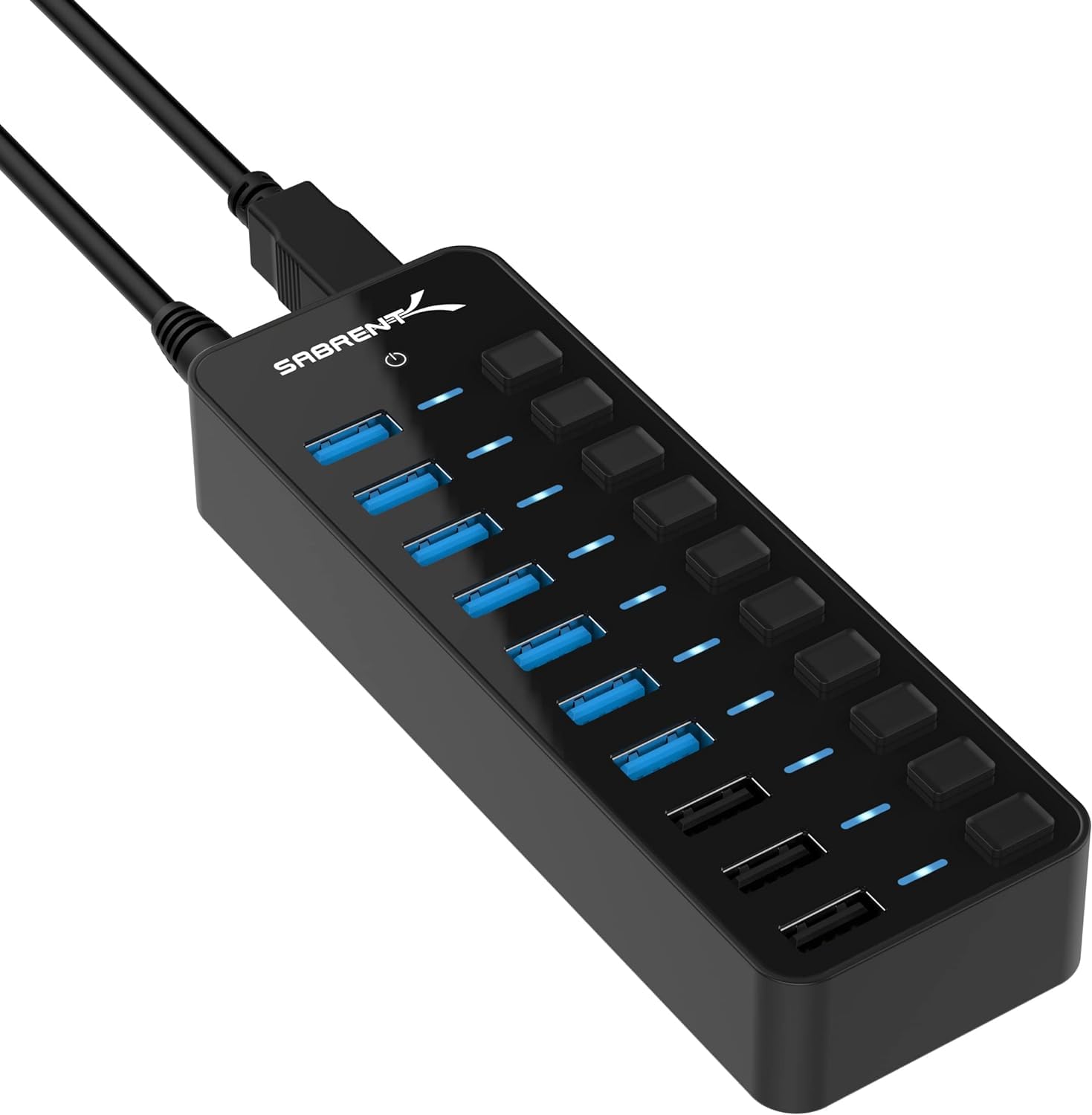
Choose the HB-PU16 if connecting more devices is the priority. The HB-B7C3 is a more relevant fit if seven USB 3.0 connections are enough and its dedicated charging ports better match your charging needs.
- The HB-B7C3 supports up to seven USB 3.0 devices at once, has individual switches and LEDs, and includes three dedicated charging ports rated up to 2.4A per port.
- Its supplied power adapter is rated at 60W.
- The HB-PU16 offers 16 downstream USB 3.0 ports, individual switches, and a blue LED for each port.
USB Hubs alternative
2,000+ ratings
Read Amazon ReviewsSABRENT HB-MC3B 4-Port USB 3.0 Hub
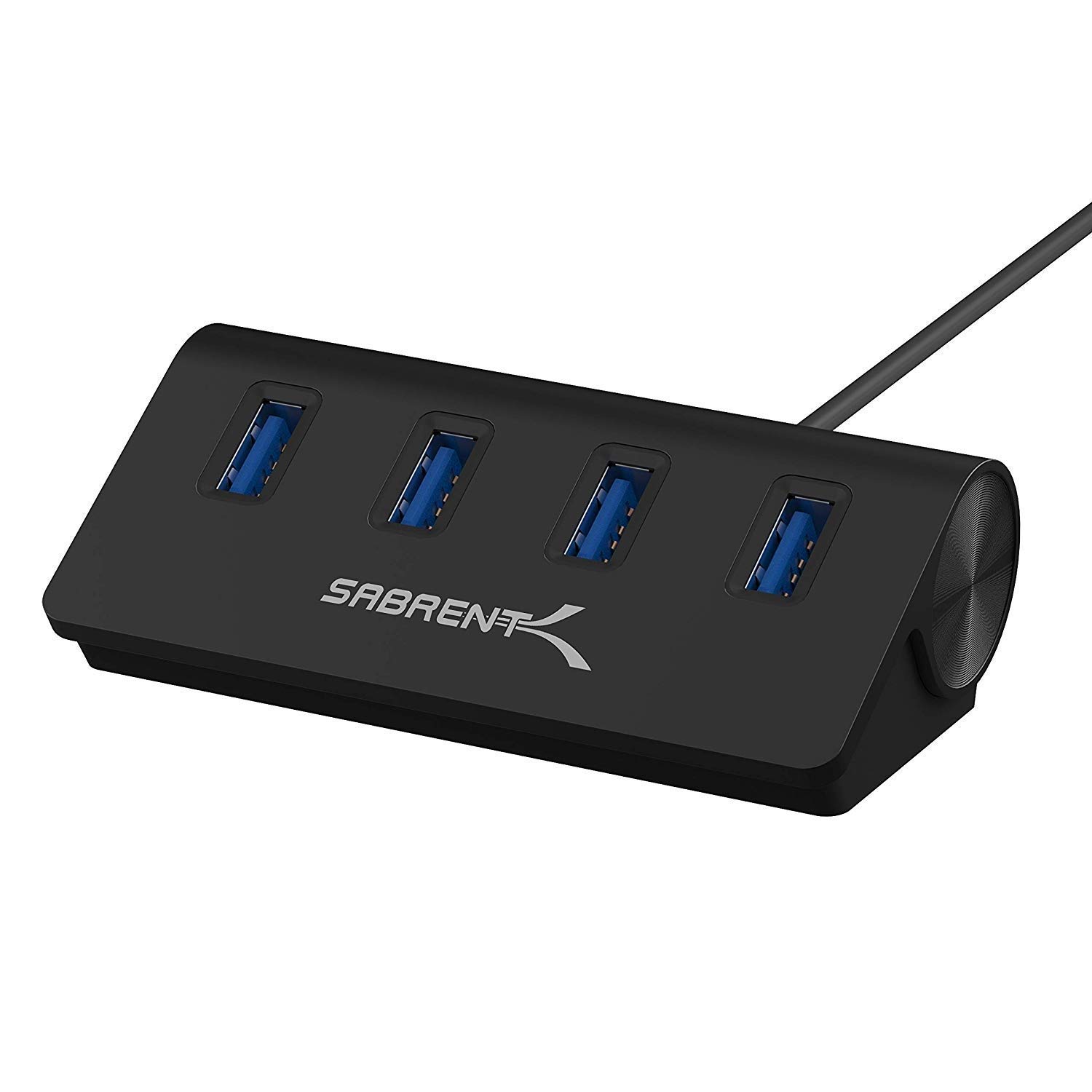
Consider the HB-MC3B if you need only a few additional USB 3.0 ports and value a portable design. The HB-PU16 makes more sense when your desk needs substantially more simultaneous connections and per-port switches.
- The HB-MC3B provides four USB 3.0 ports, supports transfer rates up to 5Gbps, and includes a 2.5-foot USB 3.0 cable. It is described as a compact, portable hub.
- The HB-PU16 is designed for a larger collection of peripherals, with 16 USB 3.0 ports and individual power switches.
Is SABRENT HB-PU16 Worth It?
The SABRENT HB-PU16 is worth considering for a desk setup that needs many USB-A connections, backward compatibility, and separate control for each port.
Its combination of 16 ports, up to 5Gbps USB 3.0 transfer support, switches, and status LEDs addresses the needs of a crowded peripheral setup.
Its large capacity is the main tradeoff: buyers who need only a few connections or depend on USB-C should check other designs.
If your devices and workspace align with its USB-A, 16-port layout, the HB-PU16 is a practical candidate for keeping a broad collection of peripherals connected.
Your review at a glance
1,000+ ratings
Read Amazon ReviewsSABRENT HB-PU16
A fit for desktop users who need many USB-A connections, individual port switches, and support for older USB devices.
- Sixteen downstream USB Type-A ports for connecting multiple peripherals.
- USB 3.0 data transfer rates of up to 5Gbps.
- Compatibility with USB 2.0 and USB 1.1 devices and transfer modes.
- Individual power switches let you manage each port separately.